A coworker recently shared this newspaper clipping with me at a meeting:
"A British researcher has confirmed what pet owners have long suspected--that animals can actually sense when their masters are coming home. Rupert Sheldrake, former director of cell biochemistry at Cambridge University, reported that 46 percent of the dogs he studied began preparing for their owners' return up to an hour before they got home, even if they worked odd shifts.
The animals usually became agitated and went to the window to watch for their owners' return. Some cats and other pets showed similar psychic bonds with their masters, said Sheldrake, who collected 1,500 case studies from around the world. One myna bird would begin shouting, 'Robbie's coming home,' when its owner was returning from a trip."
This article is from September 6, 1996 (newspaper and author unknown).
Many of us can relate to our pets greeting us when we get home as if they knew we were on our way, whether it be from the sounds of our cars or a psychic feeling as this article suggests. One of my cats greets me at the door most days (unless she's soaking up some serious sun or in a deep catnap), but she doesn't go to the door when neighbors come in the house. Maybe it's the way I walk up to the door or the specific sound of my keys jingling--I'll never know! But it's definitely always a nice feeling to be greeted by a furry friend after a long day.
Sunday, July 3, 2011


Friday, July 1, 2011
Think Twice Before Bringing Pets to Outdoor Festivals This Summer
It’s summertime in Athens, which means lots of fun outdoor festivals. Pet owners tend to take these opportunities as a cue to get their dogs out of the house, but you may want to think twice about bringing Rover with you. AthFest suggests not bringing your dog because of grass scarcity and the problem of waste disposal. But there’s a more pressing reason you should be concerned about—your pet’s health.
We can quickly become hot at events, but imagine wearing a fur coat and not being able to sweat! Animals can succumb to heat stroke in a matter of minutes if their body temperatures rise above 106 degrees, and humidity exasperates the problem. Have you walked outside lately? Temperatures have been well into the 90’s, which can be dangerous for dogs and present the potential for heat stroke.
“Signs of heat stroke are intense, rapid panting, wide eyes, salivating, staggering and weakness,” says United Animal Nations (now RedRover). If your pet has these symptoms, treat it immediately.
Other things to keep in mind: your pets’ paw pads can burn on the asphalt (try walking around barefoot and see how it feels), some dogs become nervous or get stepped on in crowds, and uncompassionate people may be mean to animals left unattended.
If you find it necessary to bring your pet, take a bowl and plenty of water, keep your pet out of direct sunlight when possible, and find cool indoor spots to cool off periodically. For more information, visit MyDogIsCool.com.
*I wrote this letter to the editor for the Athens-Banner Herald last week before AthFest, but alas it did not get published. I still think it's a very important message, and it's relevant to all outdoor activities in this summer's incredible heat and humidity. So I hope that you will take this message to heart and will share it with your pet-owning friends and family.
We can quickly become hot at events, but imagine wearing a fur coat and not being able to sweat! Animals can succumb to heat stroke in a matter of minutes if their body temperatures rise above 106 degrees, and humidity exasperates the problem. Have you walked outside lately? Temperatures have been well into the 90’s, which can be dangerous for dogs and present the potential for heat stroke.
“Signs of heat stroke are intense, rapid panting, wide eyes, salivating, staggering and weakness,” says United Animal Nations (now RedRover). If your pet has these symptoms, treat it immediately.
Other things to keep in mind: your pets’ paw pads can burn on the asphalt (try walking around barefoot and see how it feels), some dogs become nervous or get stepped on in crowds, and uncompassionate people may be mean to animals left unattended.
If you find it necessary to bring your pet, take a bowl and plenty of water, keep your pet out of direct sunlight when possible, and find cool indoor spots to cool off periodically. For more information, visit MyDogIsCool.com.
*I wrote this letter to the editor for the Athens-Banner Herald last week before AthFest, but alas it did not get published. I still think it's a very important message, and it's relevant to all outdoor activities in this summer's incredible heat and humidity. So I hope that you will take this message to heart and will share it with your pet-owning friends and family.
Article: When Lucky Died
 |
| Bob and his dog Lucky on a drive. |
When Lucky Died: A grief observed, on social media
by Bob Sullivan
Wednesday, June 15, 2011
News Story: Skunks Rehabilitated & Released
 For those of you who know me, you know that I have a special spot in my heart for skunks! I just came across this short story about nine baby skunks who were rehabilitated and released for a second chance at life in the wild. Check it out:
HSUS: Moment of Release for Nine Skunks
Sunday, June 12, 2011
Cruelty-Free Products to Think About
My newest endeavor to help animals on a larger scale involves the daily or weekly products I use--cleaning supplies, toiletries, beauty products, and other products with ingredients that are still tested on animals. Although I admit I haven't quite gotten to the point where all of my products have a "never tested on animals" label, I am slowly moving to purchasing them as I need new items. The main reason why I haven't jumped on this particular bandwagon until now is, frankly, money. So many eco-friendly, animal-friendly products tend to be on the more expensive side, which is great if you're not on a tight budget. But with the combination of a worsened economy and the populations' heightened ethical awareness on purchases has come more affordable, cruelty-free options. As I move toward cabinets filled with only cruelty-free products, I encourage you to join me.
So why is this so important, you might ask?
Millions of animals in laboratories suffer and die from testing of ingredients and products each year--products that have already been proven safe for humans or could be tested in more humane ways. And as companies become more conscious of the public's desire to purchase cruelty-free products, they have developed slogans and logos that can be deliberately deceiving and misleading to consumers. The main reason why they're misleading is because they say things such as "not tested on animals," referring to the final product but not the ingredients used to make the product at other facilities. Other companies will contract out the testing, fabricating a loop-hole for claiming that they didn't test it on animals. So it quickly becomes confusing and frustrating for those of us who really care about these labels and the truth behind them. Fortunately for us, Leaping Bunny has developed standards and a corresponding logo to help take the frustration out of shopping animal-friendly.
Leaping Bunny "works with companies to help make shopping for animal-friendly products easier and more trustworthy." Their website has an updated list of national and international companies who have proven their compliance with cruelty-free standards, which include not testing the ingredients, formulations, or finished products on animals. They even have a printable Pocket Shopping Guide and a iPhone/Android phone application for you to refer to while shopping, and the Leaping Bunny logo is printed on the majority of their approved cruelty-free products (in case you forget your pocket guide or don't have the app!). They also have an updated list of companies on their website, as they are always trying to move companies to join their cause. Check out their site for other ways you can take action on the cruelty-free product front!
Here are a few of the companies I've already switched over to (or plan to switch to in future purchases) for my household and beauty products:
HSUS, All Animals Magazine, May/June 2011. Behind Closed Doors: The Human Toll of Animal Research, by Ruthanne Johnson.
Will you join me in my journey towards an animal-friendly products home?
 |
| Leaping Bunny Logo. |
Millions of animals in laboratories suffer and die from testing of ingredients and products each year--products that have already been proven safe for humans or could be tested in more humane ways. And as companies become more conscious of the public's desire to purchase cruelty-free products, they have developed slogans and logos that can be deliberately deceiving and misleading to consumers. The main reason why they're misleading is because they say things such as "not tested on animals," referring to the final product but not the ingredients used to make the product at other facilities. Other companies will contract out the testing, fabricating a loop-hole for claiming that they didn't test it on animals. So it quickly becomes confusing and frustrating for those of us who really care about these labels and the truth behind them. Fortunately for us, Leaping Bunny has developed standards and a corresponding logo to help take the frustration out of shopping animal-friendly.
Leaping Bunny "works with companies to help make shopping for animal-friendly products easier and more trustworthy." Their website has an updated list of national and international companies who have proven their compliance with cruelty-free standards, which include not testing the ingredients, formulations, or finished products on animals. They even have a printable Pocket Shopping Guide and a iPhone/Android phone application for you to refer to while shopping, and the Leaping Bunny logo is printed on the majority of their approved cruelty-free products (in case you forget your pocket guide or don't have the app!). They also have an updated list of companies on their website, as they are always trying to move companies to join their cause. Check out their site for other ways you can take action on the cruelty-free product front!
Here are a few of the companies I've already switched over to (or plan to switch to in future purchases) for my household and beauty products:
- Method Products: They have everything from hand soap to shower cleaner to laundry detergent to baby products, and they are my favorite new top choice in my animal-friendly quest. As an added bonus, their products are non-toxic (not "dirty" ingredients) and recyclable. Available at Target, Lowe's, Kroger, and MethodHome.com for very affordable prices.
- Burt's Bees: They have natural personal care products that are good for the environment, including sunscreen, lip balm, shampoo, and even men's products. A little on the pricier side, but still affordable (most of these products last a long time, too). Available in a multitude of stores and at BurtsBees.com.
- Eco-Me: This company has household supplies, even drain cleaner, and they also have pet-care products. Shouldn't we use cruelty-free products on our pets, too?! Available at Target, Amazon, Petco, RiteAid, and Eco-Me, among others, for affordable prices.
HSUS, All Animals Magazine, May/June 2011. Behind Closed Doors: The Human Toll of Animal Research, by Ruthanne Johnson.
Will you join me in my journey towards an animal-friendly products home?
Friday, June 10, 2011
I Found a Stray… Now What?
It’s happened to too many of us—we come across a stray animal clearly in need of a new home, scoop it up, and take it home to decide the next step. But then what? Below are some ideas that you can share with friends and family who will inevitably face the same scenario. Unfortunately, there’s no quick fix for these situations, but there are definitely some things you can do with a little effort to find your stray a new forever home!
Provide medical treatment and grooming
Is it really a stray?
The first step is to decide whether the animal you’ve found is truly a stray or if it’s just been lost by its owner. Check to see if it’s wearing a collar and if the collar has tags with contact information. If it’s not wearing a collar, it may be microchipped. A quick visit to a veterinarian office or animal shelter will connect you with someone who can scan the animal for a microchip, and provide you with information to contact the owner if it does indeed have a chip.
It’s a good idea to post “found pet” flyers in your area and to post a found listing on petfinder.com, craigslist.com, and/or online newspaper classifieds. You can also call local animal shelters and report a missing pet, which they will put on file in case the owner contacts them and to check for a match in their missing pet files. Put yourself in the position of your pet getting loose and not being able to find it or know whether it’s safe or not—you would want to check around and hope that someone made some effort to help reunite you. This is not always the case, especially when an overly-neglected animal is found, but it’s just good practice to try.
*A note about posting found flyers: Sadly not all people have the best of intentions and use found posters to go pet-shopping. I suggest only putting general details about the animal. If someone calls about the posting, ask them to provide you with distinguishing markers or behavioral characteristics to be sure it’s really their lost pet. I would also ask for a photo to compare.
 |
| Stormy: The stray who meowed at our door in 2010. |
Ok, so you’re convinced the animal is a stray. How is its medical condition? If it’s in your financial power, I suggest taking it to the vet for a checkup and vaccinations. If the animal isn’t spayed or neutered, go ahead and get that done as well. You want to find the animal a new home in the best condition possible, and having it checked is going to help you find it a home much faster. And spaying/neutering it will ensure that the number of stray animals in your area will decrease.
It’s also smart to take it to the vet if you have other animals. It may have parasites or other treatable but contagious medical condition that could be spread to your pets.
*There are many low-cost spay/neuter programs that also offer low-cost vaccines. Contact your local animal rescues to find out where the nearest low-cost spay/neuter center is located. Some vets and groomers will also give a rescue discount for cases such as these.
Grooming the animal will make it clean while it’s in your care and will make it much more appealing to potential adopters. Give it a bath, clean its ears, clip its nails, and give it a good brushing. You may need help with this from a groomer, depending on the animal’s temperament and your own grooming experience.
Steps to finding a forever home
If you can’t keep the animal as your own pet for whatever reason, you’ve got to get out there and find it a new home. This is the hard part, but it can be done—just be patient!
Wednesday, June 1, 2011
Steve Schuman Art: Pet Portraits
 While walking through shops in Savannah's City Market this past weekend, I came across an artist in one of the shops who I fell in love with. His wonderfully quirky wife (wearing huge rhinestone cat earrings) told me and my boyfriend all about her husband's work. Steve Schuman uses only oil paints to create incredibly colorful pet portraits, among other subjects and media. All of his artwork available in the A.T. Hun Art Gallery are of his own pets or pets of family, extending into the hundreds! The mascot of Schuman's section of the gallery is Rocky, whose large portrait hangs above the other artwork.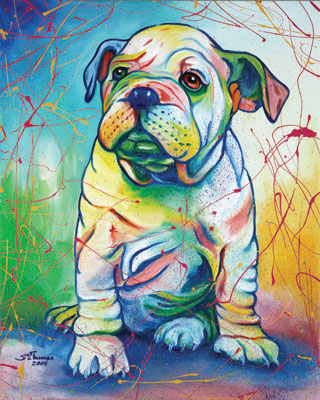

Schuman's lithograph prints are available in the A.T. Hun Gallery or online for $60, and the paintings run from a couple hundred dollars into the thousands. I believe custom pet portraits are also available upon request.
Please visit Steve Schuman's website to see more of his fabulous pet portraits and other artwork--you will not be disappointed!
Subscribe to:
Posts (Atom)